Publications
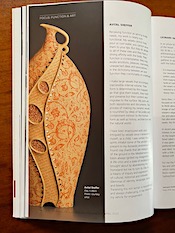
Australian Ceramics Magazine
The Journal of Australian Ceramics 60 years special edition
Focus: Function and Art
Tanversalidades en ceramica contemporanea
Exhibition catalogue: Museo de Cántir, Argentona, Spain
visit website (online catalogue)
The exhibition, Transversalidades en Ceramica Contemporanea and this catalogue aspire to provide a broad vision of the combination of all these tools of work and creation…
BAM - An interview by Nadine Absensur
Byron Arts Magazine - Issue 20
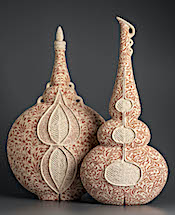
Neuma III and Neuma V
Avital Sheffer, de ceramica, vidrio y caligrafia
White Paper by: Marta Martinez
Download PDF Article — 288kb
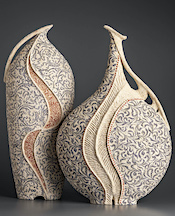
Kulmus I and Hadira IV
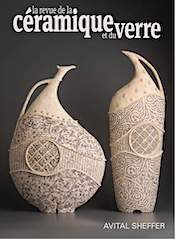
Avital Sheffer D'un Contimemt A Un Autre
La Revue de la ceramique et du verre 236
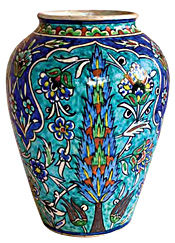
La Revue de la Céramique et du Verre - Object Fétiche: Le vase arménien d'Avital Sheffer
The article tells the story of a historical Armenian vessel I inherited and how it influenced my life and art.
Download PDF Article — 2 pages, 474kb
This article is the original French and includes English transalation.
Permission has been given to make it available on this website.
Armenian Vase
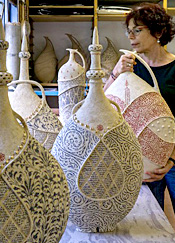
Cross Cultural Intersection
Jane Denison talks with Avital Sheffer about her Barcelona residency
The Journal of Australian Ceramics volume 56 #2 2017
Download PDF Article — 6 pages, 5.7mb
This article was published in Vol 56 No 2 of The Journal of Australian Ceramics, July 2017.
Permission has been given to make it available on this website.
© The Australian Ceramics Association 2017
Avital Sheffer Studio 2017
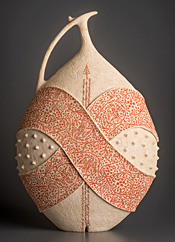
Vessels with magisterial demeanour
Exhibition Review by Kerry-Anne Cousins
The Canberra Times, August 27, 2017
(download PDF article)
"Avital Sheffer's vessels stand silent and enigmatic like sentinels at the gate of an ancient past. Their forms and decoration are at once familiar yet mysterious, readable but indecipherable..."
Agora II 2017
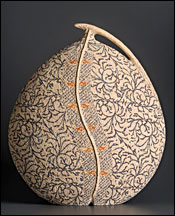
Vessels carry an elegant interplay of culture, language and form
by Peter Haynes
"Arts" in The Canberra Times, April 5, 2014
(download PDF article)
The artist's work demands multiple interpretations. It is a clear expression of an artist who relishes the richness of the traditions of her homeland and the countries around it. Its layered evocations of nature and culture, and the interweaving of these throughout history, are beautifully revealed in this splendid and consummately resolved exhibition.
Hydria I 2013
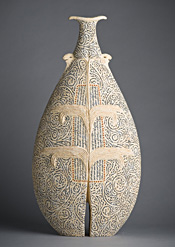
Of the Temporal and The Spiritual Works By Avital Sheffer
by Inga Walton
Ceramics Art and Perception issue no 80, 2010
(click here for full essay)
Sheffer's graceful vessels have an hypnotic quality, their undulating forms and graceful arcs murmuring to us softly of a universal artistic lineage and heightened spiritual consciousness. It is within their anthropomorphic bodies that Sheffer confides her misgivings, longing and aspirations, exorcises her feelings of unease and loss, then turns her discreet and wise accomplices over to us, so that we might do the same...
Inanah IV 2009
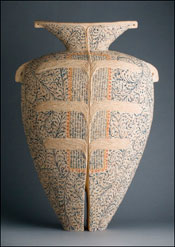
A present past/a continuous present: Recent Ceramics by Avital Sheffer
by Louise Martin Chew
Ceramic Review UK issue no 342, 2010
Catalogue essay - Deep Earth, 2009
(click here for full essay)
"Avital Sheffer's unique ceramics have a disquieting presence. The vessels she crafts are large, standing solid and stolid, the height of a toddler with the weight of a small child. Elevated on plinths they meet your gaze, adorned with texts relating ancient histories as complex and interrelated as natural systems..."
Omphalus IV 2008
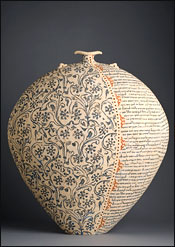
Avital Sheffer Solo Exhibition Moss Green Gallery
Exhibition review by Dylan Rainforth
The Age - Visual Art 12/11/2009
"Vessels sailing from another time to ours are how you could describe the ceramic urns of Israeli-Australian artist Avital Sheffer. Her elegant timelessly shaped vessels are inscribed with ancient Hebrew, Arabic and Aramaic texts. Many of these texts are derived from the Dead Sea Scrolls, some of the only surviving Biblical manuscripts from the period before 100AD. Although the ceramicist was little known in Melbourne previously, Sheffer's show of 17 objects sold out entirely within 48 hours of invitations being sent."
Mother Tongue I 2009
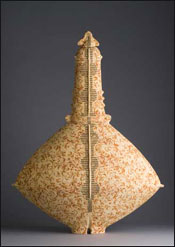
Avital Sheffer: Body of work
by Ann McMahon
The Journal of Australian Ceramics, issue no. 48#1 2009
(click here for full essay)
"By referring to the human body Sheffer touches a deep intimate chord and elicits subliminal responses... Through her artwork Sheffer explores the common ground of interwoven histories. She holds hope for the future in her gracefully proportioned containers. Their extraordinary beauty and exquisite detail invites a state of quiet yet engaged contemplation..."
Temimah I 2008
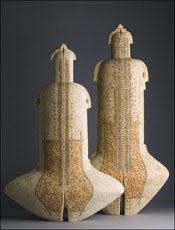
Encoded sentinels - Terra Intima
Exhibition review by Kerry-Ann Cousins
The Canberra Times October, 2008
"In these works Sheffer has refined her forms and decoration to present a beautifully coherent it enigmatic statement...."
Piryon I and II 2008
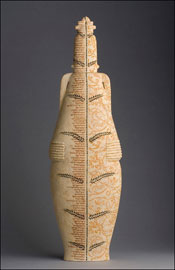
New Works by Avital Sheffer
Exhibition review by Pollyanna Sutton
Craft Arts International issue no. 72, 2007
(click here for full essay)
"The ceramics of Avital Sheffer speak of ancient civilisations but her idiosyncratic forms and refined surfaces place them firmly in the world of contemporary studio ceramics..."
Aspaklaria II 2007
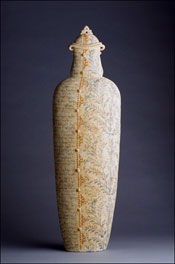
Unearthed II – Avital Sheffer
Exhibition opening address by Paul Donnelly, curator
Powerhouse Museum Sydney, 2006
(click here for full essay)
"Clearly these works are loaded with meaning on many levels, and there is much of Avital in every vessel. Through evoking the past of this rich and complex region, Avital provides a bridge from her new home to her old. Similarly, for us as observers, the detail and technical competence of these works command our attention, while being inevitably filtered through our own range of associations."
Sfat Em Mother-Tongue
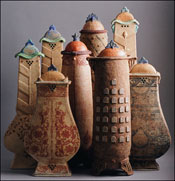
Tradition to Modernity
Feature article by Gordon Foulds
Craft Arts International, issue no. 64, 2005
(click here for full essay)
"When looking at photographs of the works of Avital Sheffer, one must be impressed by their power, their beauty and their originality, but when actually seeing them, they have a compelling presence and quality of timelessness about them which a photograph does not convey"
Group Of Vessels I
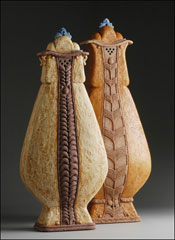
New Vessels, Ancient Voices, Ceramics of Avital Sheffer & Margaurite Josephson
Article by Steve Giese
Ceramics Art and Perception issue no. 60, 2005
(click here for full essay)
"Tradition is used by Sheffer as a departure point for her work. The spice bottle form is a graceful, vertical, usually capped by at least one but sometimes a trio of domes. Their shape is also architectural and some hold the essential proportion of the human figure... The decoration creates an intricate, busy graphic style"
Hadas I and II 2004